
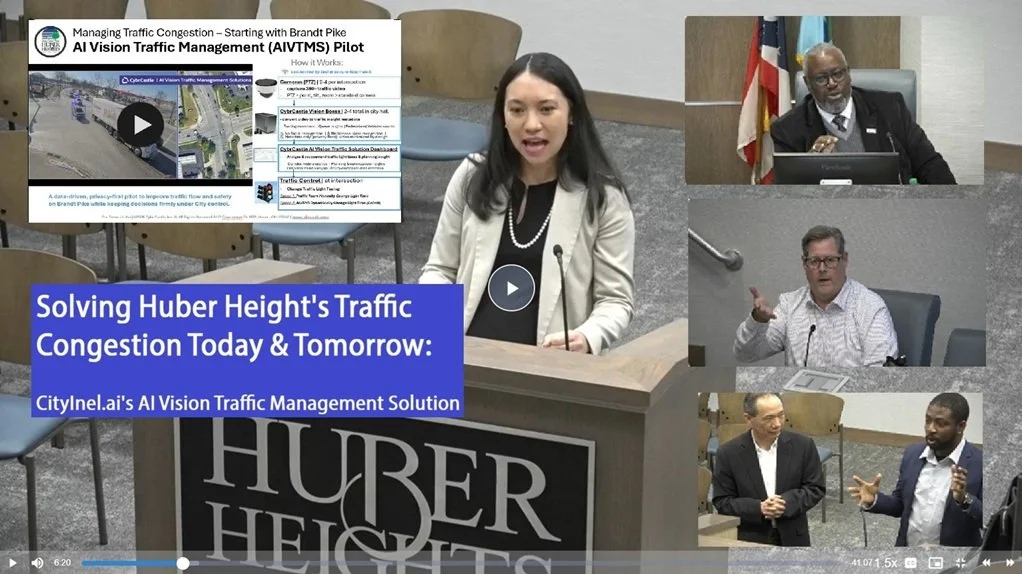
Video: Huber Heights Approves Privacy-First AI Vision to Improve Traffic Congestion
Published: February 24, 2026 | Updated: September 7, 2026 | Sabrina Donley, AI Practice Leader, CybrCastle
How did Huber Heights start using AI to address one of its biggest challenges—traffic congestion?
In early 2025, officials from the City of Huber Heights met Sabrina Donley, AI Practice Leader of Local & State Government from CybrCastle at the Ohio City and County Managers Association (OCMA) Winter Conference. Their question was straightforward:
"We know AI is part of the future, but how can it help us solve the challenges we're facing today?"
Through a strategic AI consultation, city leaders explored where AI could create meaningful value. That process led them to identify a potential application for one of their highest-priority concerns: traffic congestion.
Because traffic management directly affects public safety, quality of life, and city operations, the stakes were high. The city wanted to understand not only whether AI could help improve traffic flow, but also how to implement it responsibly with the appropriate governance, policies, and safeguards in place.
Earlier this year, City Council unanimously approved Phase 2 of the AI Vision Traffic Management Pilot.
The technology goes beyond counting vehicles or displaying congestion: it can continuously analyze conditions across multiple intersections and calculate improved signal timing based on what is happening in real time.
Just as importantly, the system was intentionally designed with privacy in mind. It does not use facial recognition or license plate recognition. Instead, video is converted into operational metadata such as vehicle counts, turning movements, queue lengths, wait times, and pedestrian volumes—allowing the City to understand what is happening without needing to identify the people who are there.
How Can AI Vision Be Used Beyond Traffic — While Maintaining Resident Privacy?
While traffic is the first use case, the same privacy-first AI Vision platform can support broader community intelligence over time, from roadway hazards and flooding to infrastructure conditions, public safety, and planning.
The goal is not simply more cameras or more data. It is better intelligence, faster response, and greater value from infrastructure the City already owns—while keeping privacy, governance, and human oversight at the center.
What is the highest-stakes challenge facing your organization today?
Is it traffic congestion? Workforce shortages? Infrastructure management? Citizen services? Budget constraints? Something else entirely?
Have you wondered whether AI could help address that challenge in a cost-neutral way while providing significantly greater capability than your current approach?
Or are you trying to determine how to leverage AI while ensuring the right guardrails, governance, and policies are in place?
Schedule a Strategic AI Consultation Today: